
Why Most Online Communities Go Quiet (And How to Fix It)
If you are about to launch a Skool community, most advice on how to build an online community skips the first question you should answer, which is whether you should build one at all.
I sat down with Catherine Eadie, the admin behind my AI Marketing Insiders community, who has been part of online communities since the late 1990s and ran one of her own for over a decade.
How to Build an Online Community Video Guide
Catherine and I recorded this episode because every AI creator on the internet seems to be launching a Skool community right now.
She has watched this exact pattern play out before, with different topics, going back to newsgroups.
Her opening argument was not the one I expected from someone who runs a community for a living.
If you want the setup my members actually learn once they are inside, I put together a Claude Code Skills Stack with the workflows and templates I run my own business on.
Start By Asking If You Should Join Instead
Catherine's first point was blunt, and it undercuts most of the launch advice out there.
"I look at a lot of communities and think they could go and join someone else's," she said. "They don't need to create their own necessarily."
The distinction she draws is between wanting a community and having your own idea for one.
She calls that second thing community ownership, and thinks the honest reason to own rather than join is controlling the narrative.
A lot of the current wave, in her words, is "kind of a lot of it is are echo chambers."
I keep a running list of the ones I think are worth paying for in my roundup of the best AI communities, and it is a short list for exactly this reason.
"AI communities are the thing just as many years ago something else was the thing for communities," she said. "And then they eventually dwindled off."
That history matters if you are deciding where to spend the next two years. The theme has changed more than once in her experience while the underlying dynamics stayed identical.
My own reason for owning one is economics. You control the distribution and the revenue recurs, which a one-off course sale does not.
Both things can be true. The wave will pass, and owning the room is still better than renting attention on someone else's platform.
Get Your ICP Right Before You Chase Growth
The fastest way to wreck a community is to fill it with the wrong people.
Instead of telling everyone interested in AI to join, you need a narrow ideal customer profile. Shotgun recruiting is what makes churn rates terrible.
Here is the mechanic. Someone joins, decides the room is not relevant to them, and then either lurks forever or cancels outright.
I will admit on the record that mine is still too wide. Business owners, marketers, and content creators is three audiences, and saying it out loud made me realize we need to narrow it further.
Catherine added a churn cause I had not considered, which is that some people join because they feel obligated to.
"People thinking that they need to be looking at AI," she said. "Everyone's being told to upskill themselves and find out about AI."
Those members were never going to stay. They joined out of fear of falling behind, not because they had a problem your community solves.
She suspects AI-era churn numbers are probably inflated by people who never needed to be there in the first place.
Lower Your Expectations on Engagement
Catherine cited a participation split that stops most new community owners cold.
"Around about 90% of people lurk in communities, just generally, wherever they're based," she said. "About 9% comment and only 1% do actually create the most of it."
She was working from community engagement material she had been reading rather than her own data.
The ratio matches the 90-9-1 rule of participation inequality that Jakob Nielsen documented in 2006, which is worth knowing before you panic about your own numbers.
Her advice is to lower your expectations a little rather than fight it, because lurking is a given.
She also pointed out that raw member counts hide dead accounts, because cancelling a subscription is annoying enough that people simply forget.
I would add a warning about the numbers you see advertised. You can invite people for free, pad the roster with friends, and present a five-figure member count that nobody is paying for.
Facilitate Instead of Telling People What to Do
Catherine's operating philosophy comes from education, and it is the sharpest distinction in the whole episode.
"I always talk about being a facilitator, not a trainer," she said. "I'm not there from a university to lecture."
The failure pattern she sees everywhere is a feed of instructions. Do this, try that, go to this website, use this tool.
Facilitating looks different. You guide someone toward working out what will actually move them forward, then let them do it.
She has a concrete test for whether it is working, and it is not the like count.
"A lot of communities the comments are very short," she said. "Oh, that was great. Thanks very much. Doesn't add a lot of value."
What she wants instead is a thread that keeps going. Someone posts what they built with a screenshot, another member says they do not understand a piece of it, and the conversation continues from there.
Screenshots do a lot of work in that pattern, because showing the thing beats describing it.
Show Up Yourself, on Calls and in DMs
The single biggest thing we do is the weekly live call I host for VIP members.
It is real-time Q&A where people can put me on the spot, which is the opposite of what most communities offer. In too many rooms you get an AI-generated reply to your comment, or you never speak to the creator at all.
Catherine's signal that these calls are working, pointing at our recent Friday catch-ups, is that they run long.
"We've often got the time and we're still chatting away when time's up," she said. "Often you're having to call time and say, no, I need to head off now."
She rates direct messages just as highly as the calls.
She described a member flagging a spam DM in our community a few weeks back, which she sorted out. That small exchange does more for retention than any automated sequence would.
Her summary of the whole retention problem is almost aggressively simple.
"It's that personal interactions through your live calls, your DMs, and just being a nice person," she said. "Be human. Be nice. Be kind. Be respectful. Help people out."
There is a reason that lands harder now than it would have three years ago. As AI floods every channel, people are craving proof they are talking to an actual human.
Promise a Real Deliverable, Not Autopilot
The most common lie in community marketing is that you will join, receive a swarm of agents, and run your business hands-off.
That is not how any of this works. Agentic setups without context produce slop, which I have said enough times that my members can probably recite it.
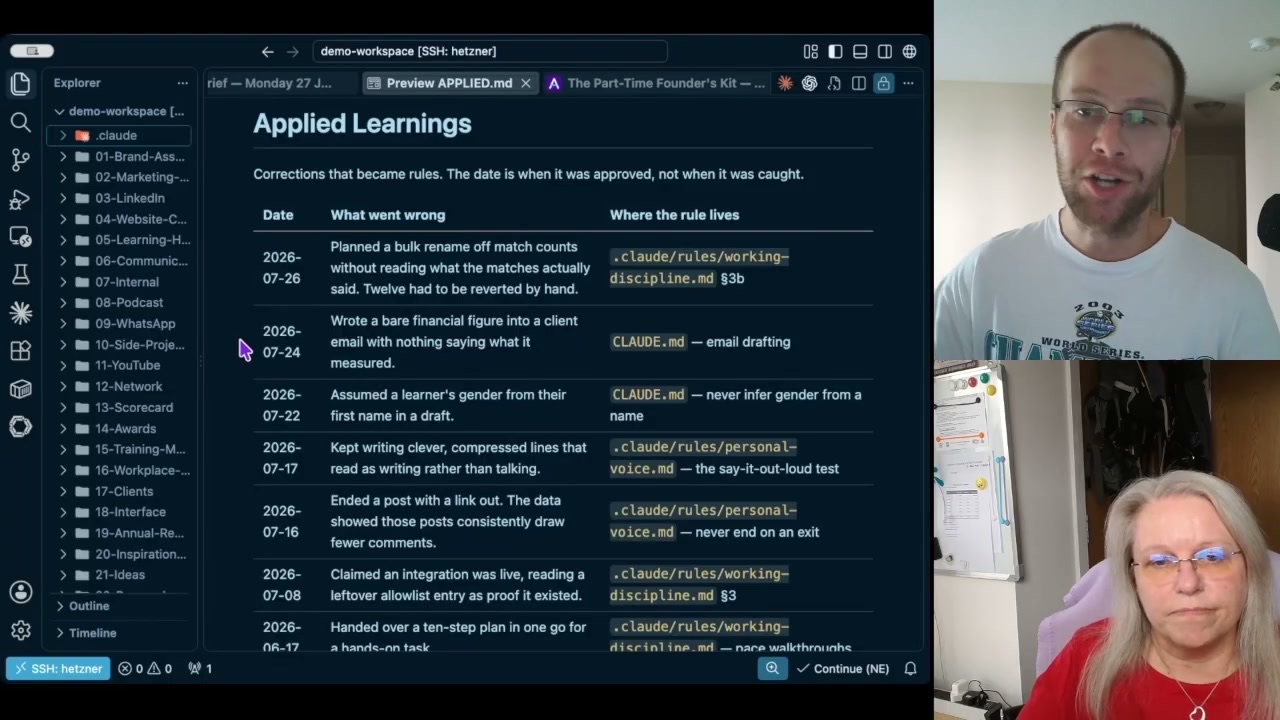
People need direction, then they need to do the work themselves. Ours is specific: get comfortable setting up Claude Code, build your own skills, and move off the chat-window habit toward tools that actually run your knowledge work.
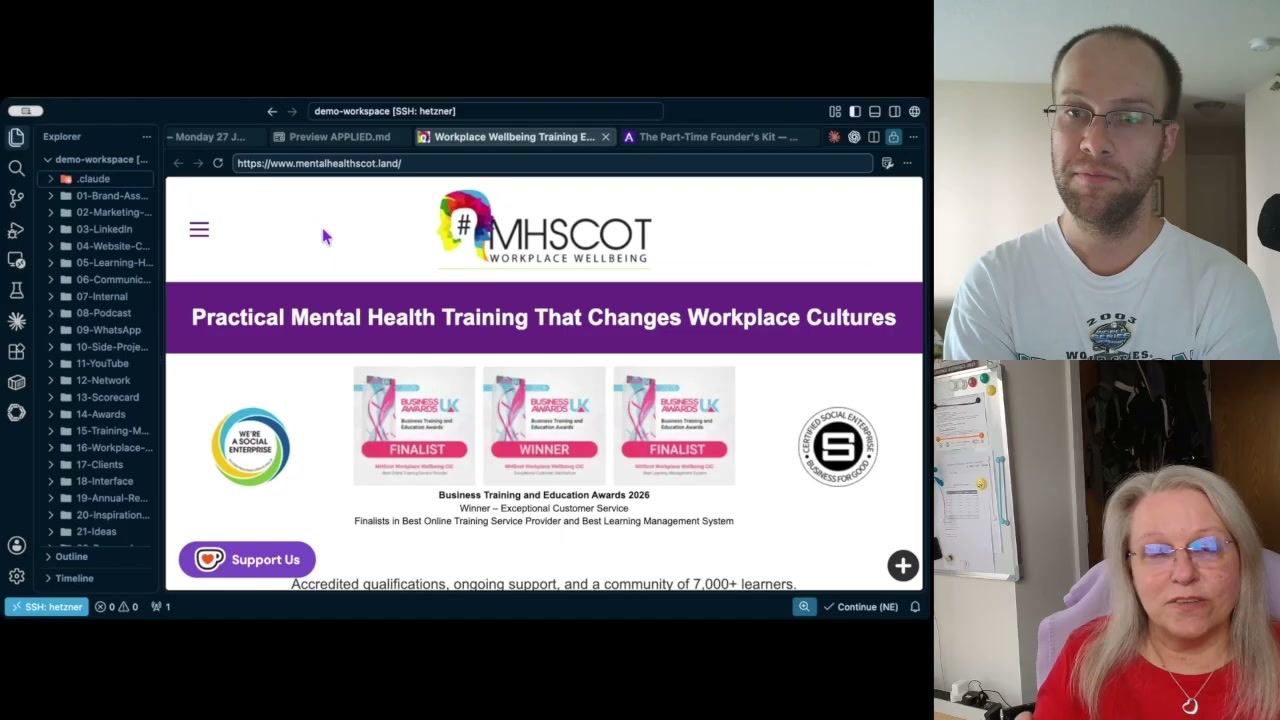
Catherine is the proof that it lands. She moved her workplace wellbeing site, established since 2014 and running to what she estimated at 23 or 24 pages, off WordPress onto a modern stack.
She says the transition itself is done, with finer tweaks still ahead, and reports getting through her priorities in roughly 70% less time than before.
One change she showed me took under a minute. She had switched from Zoom to Teams, and the word "Zoom" was still sitting on eight pages of her site.
Eight pages, one word, done in under 60 seconds.
She started from one of my Astro walkthroughs, and if you want the same workflow my AI website tutorial covers it, alongside my written guide to building a website with Claude.
She now documents her own AI work at AI Runs My Business and on her YouTube channel.
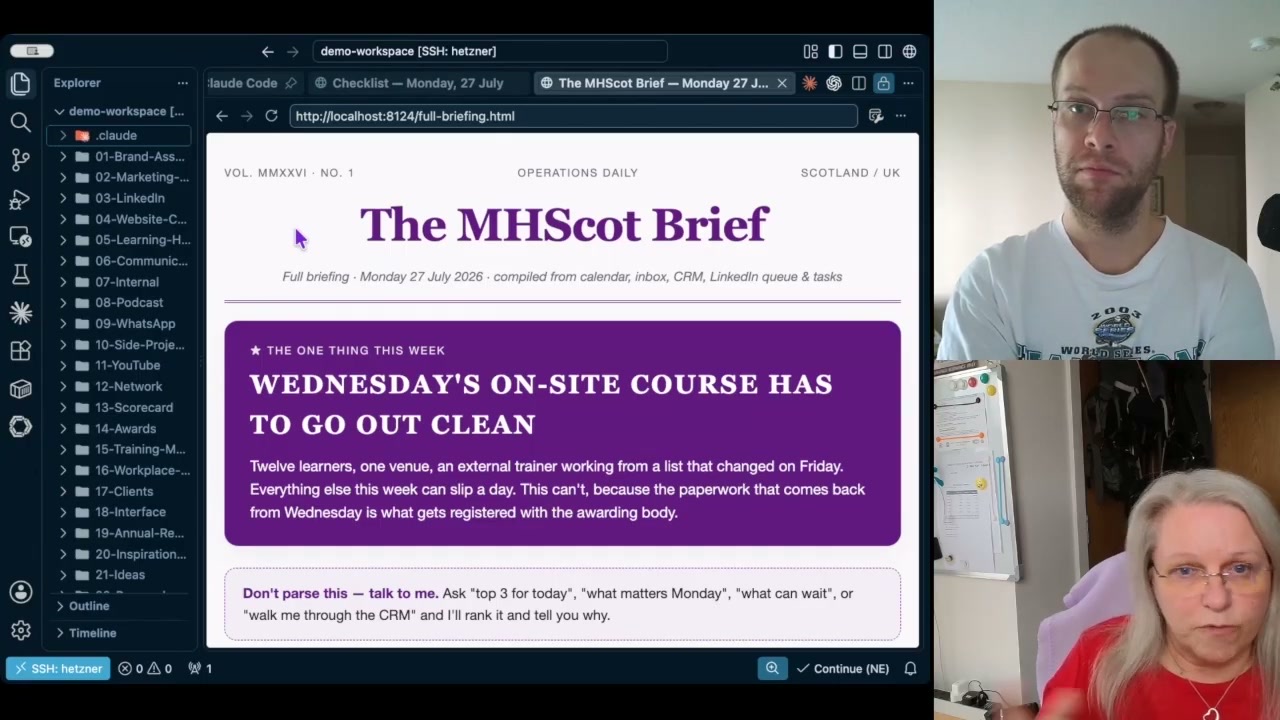
That is what a deliverable looks like. Not a promise about agents, but a member with a shipped thing she can point at.
Measure Member Outcomes, Not Member Counts
Catherine kept returning to one instruction about metrics.
"We need to move away from metrics," she said. "Forget the numbers."
Her version of a win is one person who got somewhere, which she rates above thousands of accounts doing nothing at all.
Mine works the same way. A member took the SEO skills I share and used them to run an audit and win a client worth 10 to 15 thousand dollars.
That is worth more to me than the subscription revenue, because somebody actually built something with what we taught.
Catherine's twelve-month prediction is the reason this matters more every month.
"AI kind of makes writing a good post free," she said. "But it's not evidence of anything really. It's people being there."
Read that twice if you run a community. When a polished post costs nothing to produce, post quality stops proving your room is alive.
What survives as a signal is the richness of the content and whether people actually learned something from it.
She is not predicting the weaker rooms disappear. Her view is that they probably stick around, and it comes down to the person running each one.
Final Thoughts from Ryan
If you are deciding whether to launch, take Catherine's test seriously and check whether you could just join someone else's room instead.
Already running one? The work is narrower than most advice suggests. Tighten your ICP, show up on calls and in DMs, hand people direction they can act on, and judge yourself on what members ship.
The AI wave will pass like every theme before it. Communities built on a real person helping real people are the ones still standing when it does.
How to Build an Online Community FAQs
Should I start my own online community or join an existing one?
Join an existing one unless you have a specific idea you want to develop yourself. Catherine Eadie's test is whether you actually need your own room or whether an existing community already serves that need. The legitimate reason to own rather than join is controlling the narrative around your own concept, not simply wanting a community to exist.
What percentage of community members actually participate?
Roughly 90% lurk, 9% comment occasionally, and 1% create most of the content. This split is known as the 90-9-1 rule of participation inequality, documented by Jakob Nielsen in 2006. Catherine Eadie cited the same ratio on the episode and her advice is to lower your expectations accordingly, because lurking is the normal default rather than a sign your community is failing.
How do you reduce churn in a paid community?
Start with a narrow ideal customer profile instead of recruiting everyone interested in the topic. Members who join a room that does not match their situation either lurk or cancel. After that, churn comes down to showing up personally through live calls and direct messages, plus giving members direction specific enough that they can act on it and see a result.
Does a high member count mean a community is good?
No. Ryan Doser warns that counts can be padded with free invitations, so a roster in the tens of thousands can represent very few paying members. Catherine Eadie adds that dead accounts accumulate because cancelling is inconvenient enough that people forget. Look instead at whether conversations continue past a single comment and whether the creator responds personally.
How is AI changing online communities?
AI makes a well-written post free to produce, so post quality no longer proves a community is active. Catherine Eadie's prediction is that the differentiator becomes the richness of the content and the valuable learning members get from it. She adds that weaker communities will probably stick around anyway, since it comes down to the person running each one. Ryan Doser's related argument is that as AI content spreads, members increasingly crave live human interaction.