
Astro vs WordPress: What to Use Instead of WordPress
Ask ChatGPT or Perplexity to settle Astro vs WordPress for a small business, and both pick WordPress because Astro needs a developer (as of November 19, 2026). Sam Rexford and I both left WordPress anyway, and we let an AI coding agent do the building while we review and approve.
Watch Sam Rexford and Me Break Down Astro vs WordPress
Sam builds sites and apps on Cloudflare with AI agents, and he left WordPress a year or two ago. I rebuilt ryandoser.com off WordPress this summer, and on my latest AI Rabbit Holes episode we compared the stack we both switched to.
Astro is a free, open-source web framework that turns plain text files into fast, static web pages. WordPress is a content management system that stores your pages in a database and runs them through a dashboard, themes and plugins.
That difference matters more now, because the tool that edits plain files best is an AI coding agent. The website designer and SEO skills I hand mine live in my Claude Skills Stack.
My Astro vs WordPress Verdict for 2026
Pick Astro if you run a site alone or with a tiny team and you'll let Claude Code or Codex do the building. Stay on WordPress if a team of editors needs separate logins and permissions, or if your business is deeply invested in a WordPress site that works.
I hold that verdict loosely. As I put it to Sam, Astro is "the best solution right now for what I'm doing," and if something better comes out, I'll drop it.
Sam is softer than I am. "My argument is not that you should stop using a CMS if it's right for your team," he said, even though he thinks "most people don't need a CMS at this point."
| Question | WordPress | Astro + an AI agent |
|---|---|---|
| A site-wide SEO update (my experience) | Edit each page in wp-admin, then repeat | One sentence to the agent |
| Adding a feature | Install a plugin | Have the agent build it, or install an agent-ready app |
| Several editors with permissions | Built in | Not its strength |
| Where add-ons come from | Plugins from thousands of outside developers | Code your agent writes, or an app you install |
| Hosting to start | A host that runs PHP and a database | Cloudflare's free plan |
Astro Needs a Developer. Claude Code Is the Developer Now
That "needs a developer" answer was true when the developer had to be a person. I first made this case in my WordPress alternative breakdown in September, and Sam got there on his own.
Sam's point is that coding agents are "deeply trained" on Astro. "You don't need to go find a bunch of how-tos or guides or skills," he said, because the agents already know it.
Astro's own docs even offer an official MCP server, a connector that feeds AI tools current Astro documentation.
Here's how I explain Astro to anyone coming from WordPress. It's like a WordPress theme, "but it's a framework for AI agents to follow."
You don't have to learn it either. Copy the astro.build URL, paste it into Claude Code or Codex and say "use Astro to help build my site."
You still review the plan and approve the result.
And if the agent breaks something, you're not stuck. GitHub saves every version so a bad change can be rolled back, and Cloudflare can build a free preview link if you have the agent work on a separate branch first.
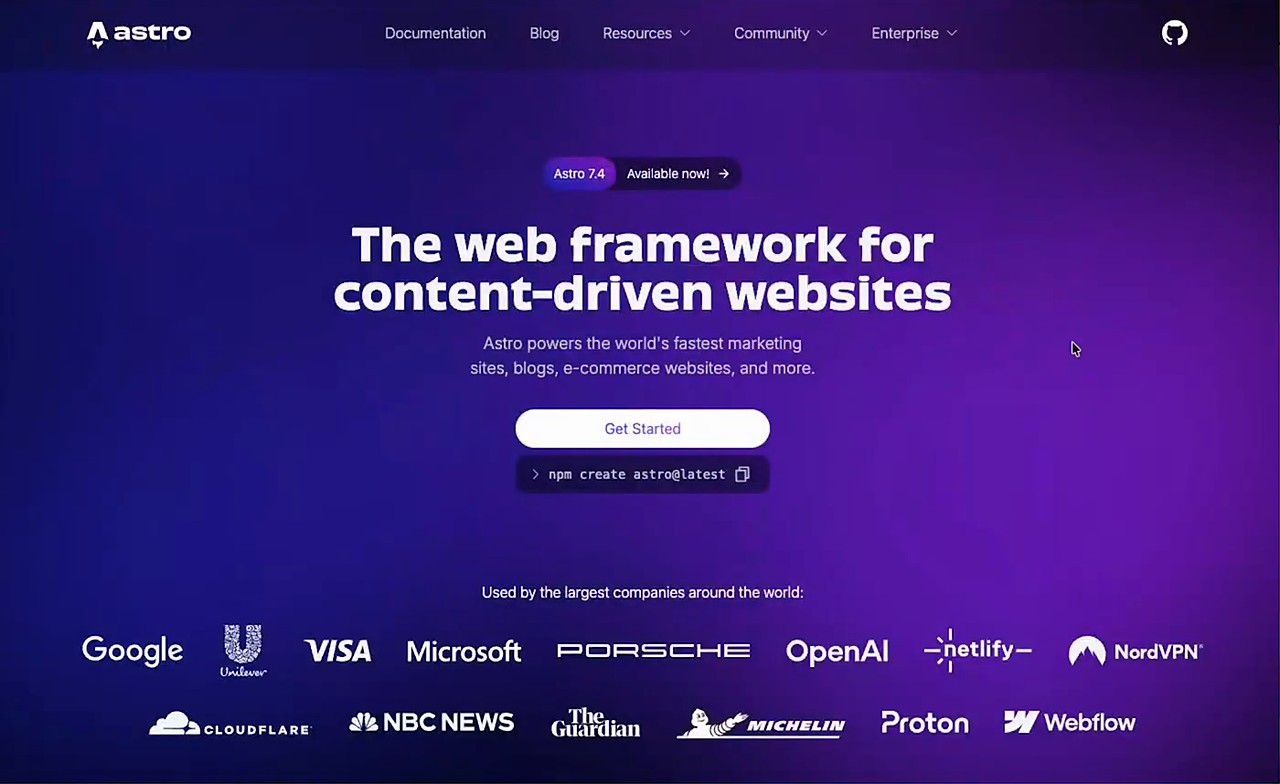
Astro also has a new owner behind it. Cloudflare announced on January 16, 2026 that the Astro team is joining the company, and that Astro will stay open source.
Your content gets simpler too. Sam stores everything as markdown files, so "a simple blog post is a markdown file in the repo," and GitHub "acts as your CMS in a way."
Cloudflare then deploys each change from GitHub to the live site. I call a private GitHub repo "Google Drive on steroids," and my plain-English guide to using GitHub covers it without the jargon.
Sam thinks most people will never hit Cloudflare's free limits, and static pages are free to serve there. The next step up, for sites that run server code, the Workers Paid plan, starts at $5 a month on Cloudflare's pricing page as of November 19, 2026.
I'm on that plan myself, and I'm not sure I've ever needed it. The recurring cost in an Astro vs WordPress switch is the AI subscription that runs Claude Code or Codex, not the hosting.
Sam put it more bluntly: "Claude Code is your technical CTO." Even Cloudflare's own CMS, which I covered in my EmDash CMS episode, is "massive overkill" for him.
The Astro vs WordPress Difference I Feel Every Month
Here's the workflow that makes me glad I'll never touch WordPress again. In SEO you're always refreshing dates, like 2025 to 2026 or February to March, across titles and body copy.
On WordPress that meant opening every page, updating the title and the body, clicking update, going back to the dashboard and repeating. Now it's "one slash command or one sentence at most," and it deploys on its own while I work on other things.
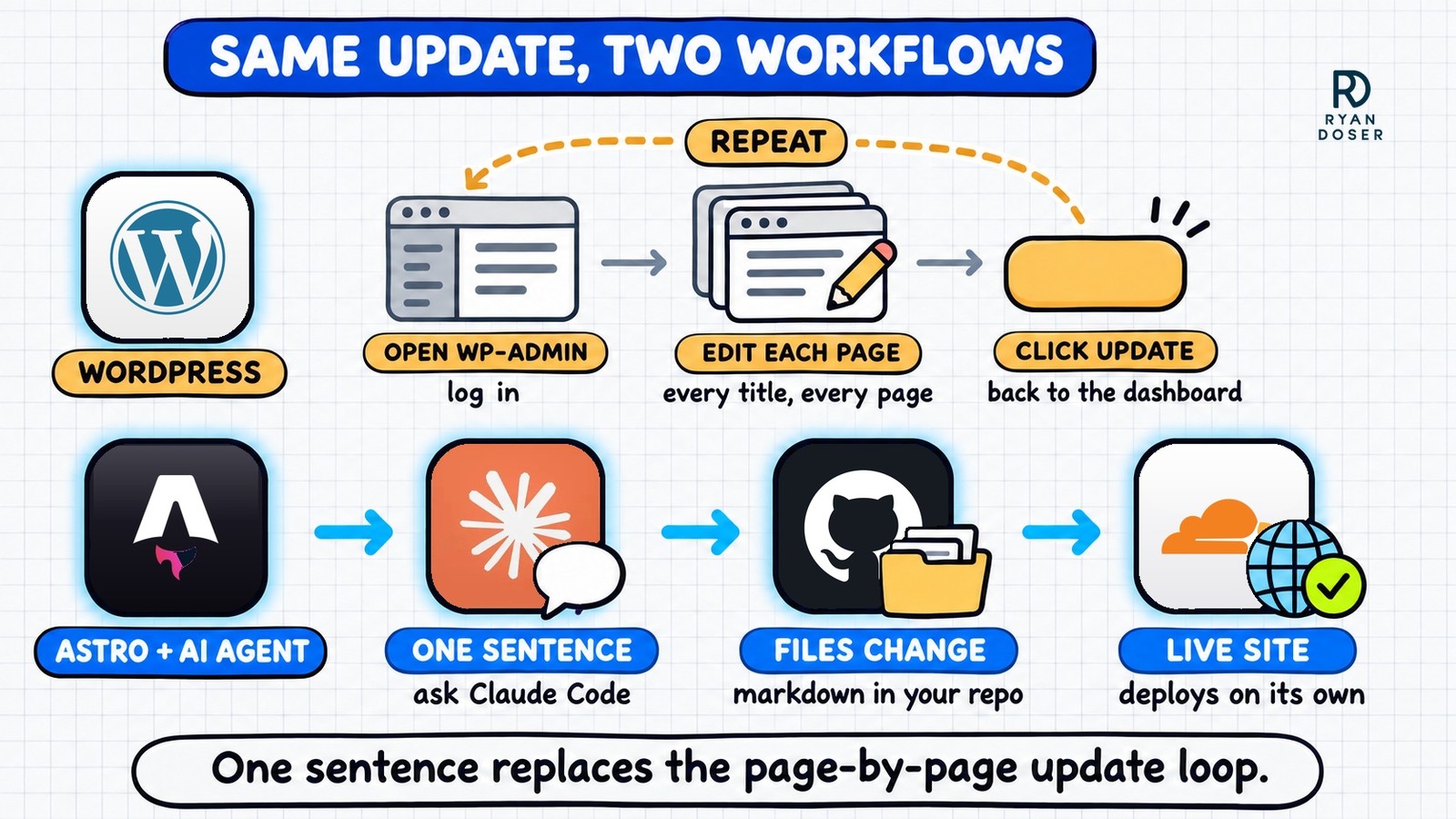
Internal links work the same way. I used to run Link Whisper for them, and now I ask Claude Code to "run an internal link audit," rank the options by priority and wait for my yes or no.
On Astro, the agent edits the same files a developer would, so a site-wide change becomes one request.
What Happens to Plugins When You Leave WordPress
"What about plugins?" is a pushback I always get, and it's where the Astro vs WordPress gap looks widest. WordPress.org's directory listed 75,646 of them on November 19, 2026, and Sam sees every one as a risk.
"Every single one of these plugins is a vector," he said, and a plugin only has "to do one thing wrong for it to impact your production site." On the episode I claimed I could recreate an SEO plugin like Yoast or Rank Math in five minutes by pointing Claude Code at its website.
Five minutes is a stretch for a full plugin. The idea holds, though: an agent can rebuild the parts of a plugin your site actually uses.
Sam's answer is a product, so know that he sells it. Sundogs is a set of mini apps that install into your own Cloudflare account, set up by your AI agent, which he called "kind of like a WordPress plugin, but for vibe coders."
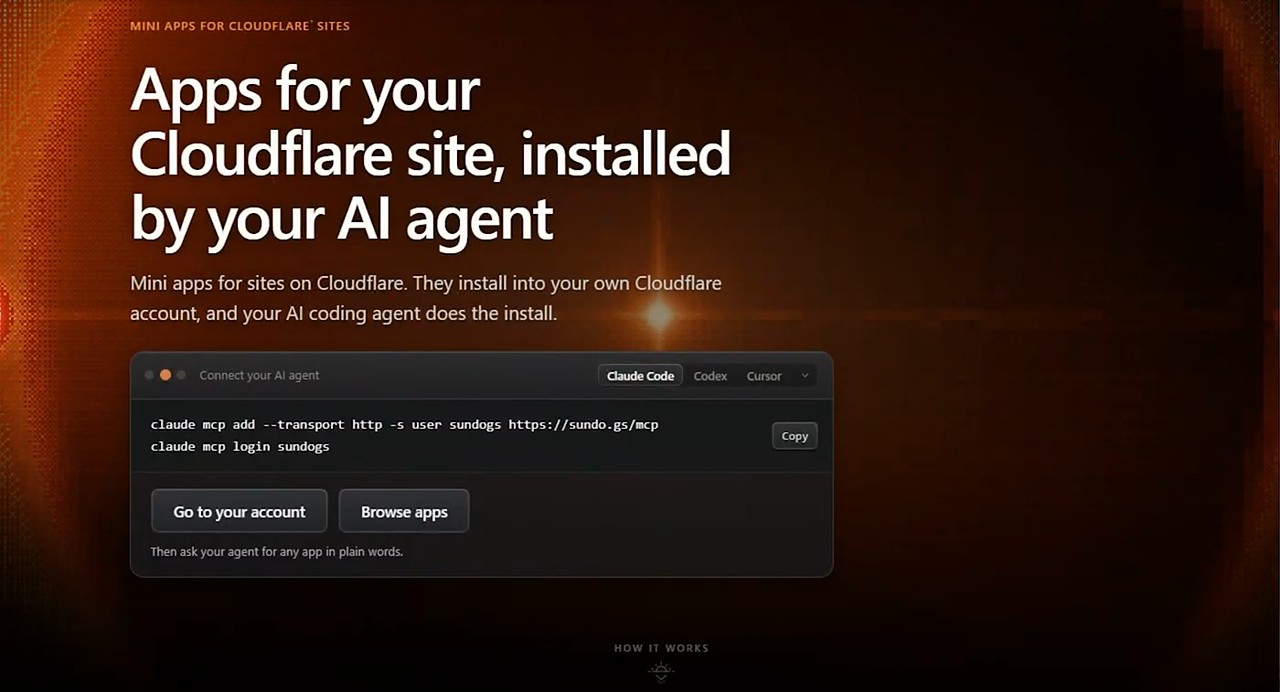
His most useful line was an honest one about his own product. "You could vibe code a lot of these things yourself," Sam said, and it "could take you 10 hours to a week to build one."
Sam framed the trade this way: "is it worth it for you to spend a week rebuilding someone's SaaS just to save twenty bucks a month?" Weigh your time against the license, then decide.
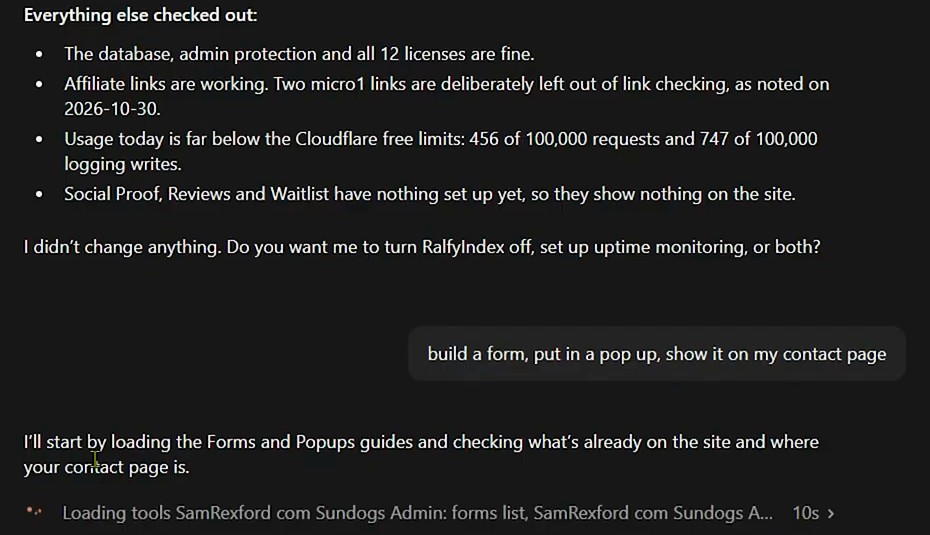
On screen, Sam asked his agent to "build a form, put in a pop up, show it on my contact page" right after it finished a health check on his site.
When WordPress Still Beats Astro
The pushback I respect comes from bigger teams. When 100 or 200 people touch a site, with forms and integrations everywhere, "some of it is valid when you have a lot of cooks in the kitchen."
Sam agreed that a CMS earns its keep for a bigger team that needs permission structures, especially once interns and new hires need oversight. For solo builders, affiliate sites, personal sites and e-commerce, his view is "I just don't think you need it."
For anyone deep into WordPress who just wants AI help, I asked Sam why not connect a WordPress MCP to an AI setup instead. He said "I think you can and you should" if you're deeply invested, while you slowly explore other options.
He still calls WordPress brittle, because every plugin is "built by different developers" with different conventions. He just won't tell you to stop: "you really have to evaluate for yourself what is the right thing for you and your business."
Whatever you pick in the Astro vs WordPress call, WordPress isn't going anywhere soon. W3Techs had it on 38.5% of all websites and 57.4% of sites with a known CMS on November 19, 2026, which corrects the "50 or 60%" guess I made on the recording.
How to Try Astro Without Migrating Your WordPress Site
One small page is the cheapest way to run your own Astro vs WordPress test. My advice is to start with a landing page, and Sam's is to "build a little test project before you do a big migration."
- Pick one page to build, like a landing page on a subdomain of your current domain.
- Make free GitHub and Cloudflare accounts, where the code lives and where the page gets served. GitHub's free plan includes unlimited private repositories.
- Open Claude Code or Codex and use Sam's starter prompt: "scaffold a project for me with Astro, GitHub, and Cloudflare."
- Paste the astro.build URL and describe the page you want in plain English.
- Review the free preview link Cloudflare builds, then connect the subdomain once the page looks right. If your domain's DNS lives somewhere else, expect one extra DNS step with your DNS provider.
My guide to vibe coding a website as a non-coder runs a full build from one prompt, including the setup accounts you need.
Sam's view is that you don't need to be technical. "You just need to have the curiosity" to tell the coding agent what you want, he said.
Start With One Page, Then Decide on WordPress
For a solo marketer with an AI agent doing the building, my Astro vs WordPress pick is Astro: a fast, simple site with no plugin treadmill. If a team of editors needs permissions, WordPress keeps its edge.
Build one page this week, and let that page make the call.
Astro vs WordPress FAQs
What is Astro JS?
Astro is a free, open-source web framework that turns plain text files into fast, static web pages. Sam Rexford's point is that coding agents like Claude Code and Codex already know it well, and Astro's docs offer an official MCP server for AI tools. Cloudflare announced in January 2026 that the Astro team is joining it, with Astro staying open source.
Is WordPress still relevant in 2026?
Yes, by usage. W3Techs counted WordPress on 38.5% of all websites and 57.4% of sites with a known CMS on November 19, 2026. Those numbers count sites, and they can't tell you whether it fits your team. It still makes sense for teams with many editors and permissions, while a solo marketer with an AI agent has a lighter option.
Is Astro good for SEO?
Astro gives you a strong technical base: it builds static pages by default, which helps them load fast and gives crawlers and AI agents real text to read. Rankings still come from content and links. The bigger SEO win is upkeep: one request updates dates across every page, and internal-link suggestions come back ranked for your yes or no.
Can Astro replace WordPress for a small business?
For a small business with one person running the site, often yes, if an AI agent does the building. Hosting can start free on GitHub and Cloudflare, so the recurring cost is the AI subscription behind Claude Code or Codex, plus Workers Paid from $5 a month only if your site runs server code. For plugins, an agent can rebuild just the parts you use, or you can pay for an app. Start with one landing page.